

Vitamin C for the SkinWhy the Form Matters
Radiant.
Even. Clear.
Vitamin C can do that.
If it ever reaches the skin
at all.
Because pure vitamin C
breaks down quickly.
And often irritates.
Evens out without masking. Not aggressive, but stabilizing.
What vitamin C does for the skin
Vitamin C is one of the most thoroughly researched active ingredients in skincare. It is a powerful antioxidant that neutralizes free radicals caused by the sun, pollution, and stress. At the same time, the skin needs vitamin C to produce collagen.
In addition, it has an effect on the complexion. Vitamin C slows down the production of excess melanin. Dark spots and irregularities fade over time, making the complexion look brighter and more even.
Vitamin C at a glance
- Even complexion
- Evens out uneven pigmentation and softens dark spots.
- Protection
- Neutralizes free radicals and protects against oxidative stress throughout the day.
- Collagen
- Stimulates collagen production. Makes the skin look firmer.
- Radiance
- The complexion looks fresher and clearer.
Why the form matters
Pure vitamin C, L-ascorbic acid, is highly effective but unstable. Light and air break it down quickly, often before the bottle is even opened. It also requires a low pH, which irritates sensitive skin. Many women over 40 know this: stinging, redness, tightness.
Ascorbyl glucoside is the most stable and skin-friendly form of vitamin C. It does not break down and is only converted into active vitamin C in the skin. Right where it is meant to work. No breakdown. No irritation. Full effect where it counts.

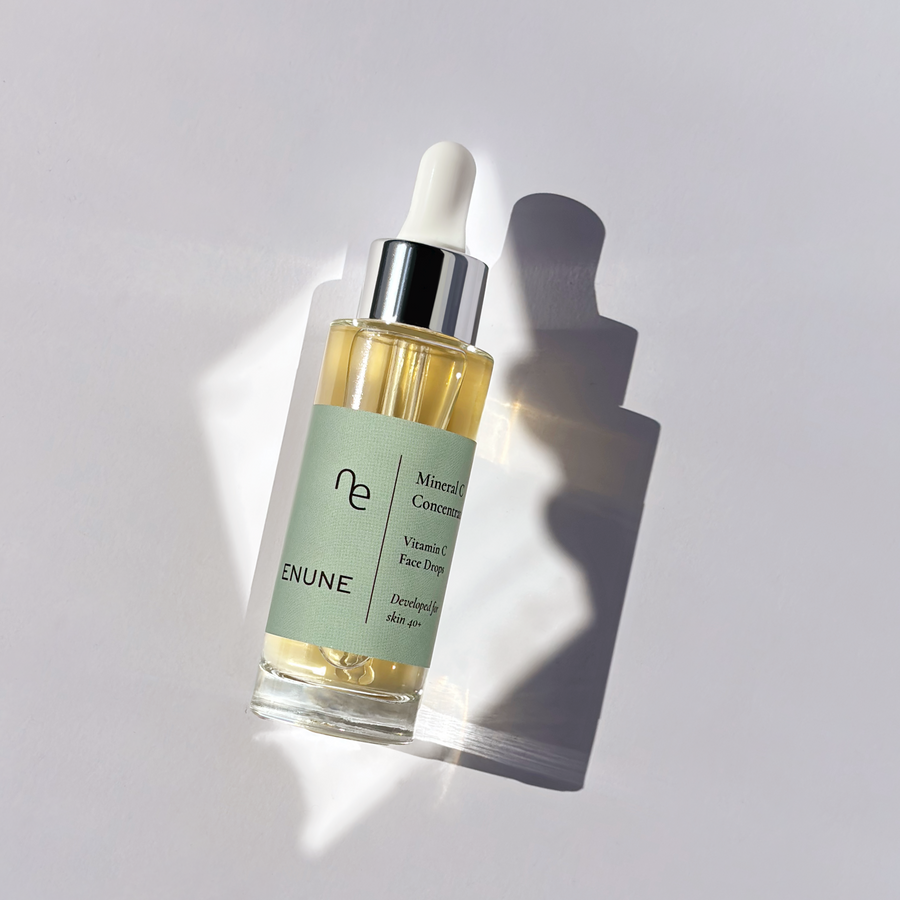
Ascorbyl glucoside is the most stable form of vitamin C. Proven effective.ENUNE on Mineral C Concentrate
Vitamin C alone is not enough
In Mineral C Concentrate, vitamin C works with three companions. Witch hazel, cactus, and zinc soothe, clarify, and regulate, visibly from the first application. Sea salt provides magnesium, potassium, and calcium and creates the foundation so that all the other active ingredients can work deeper.
Vitamin C builds on this. Long-term. Lavender and petitgrain give the serum its clear, fresh scent.
How to apply vitamin C
In the morning. Vitamin C protects against free radicals during the day. That is why it belongs in the morning routine.
After moisturizer. First Hydro Concentrate, then two to three drops of Mineral C on cleansed skin.
With sunscreen. Vitamin C complements sunscreen but does not replace it. Together, they provide the best protection.
Frequently Asked Questions
Does vitamin C make the skin light-sensitive?
No. Vitamin C does not make the skin more light-sensitive. On the contrary, it supports protection against light stress. Sunscreen remains important, however.
Is vitamin C suitable for sensitive skin?
Yes, in a stable form like ascorbyl glucoside. It irritates significantly less than pure ascorbic acid.
Can I combine vitamin C with bakuchiol?
Yes. Vitamin C in the morning and bakuchiol in the evening is best. This way, protection and regeneration complement each other.
When will I see results?
A fresher complexion often appears after a few days. An even skin tone takes about eight to twelve weeks.
Sources
Pullar J. M., Carr A. C., Vissers M. C. M. (2017): The Roles of Vitamin C in Skin Health. Nutrients, 9(8), 866.
Telang P. S. (2013): Vitamin C in dermatology. Indian Dermatology Online Journal, 4(2), 143–146.
 The 3-Minute Effect: When Science Becomes Visible
 Against dependency: Why good skincare should make the skin stronger, not more needy
 Skincare routine from 40 onwards: Fewer steps, the right order
